Field note 4 · Drones
How a drone flies without wings
A quadcopter has no wings, no tail and no rudder. It flies, steers and balances using nothing but the speed of four motors, and a computer that never blinks.
Everything else FlightLab builds has wings. A glider's wing stays still while the aircraft moves, and the moving air does the lifting. A drone turns that idea inside out: the aircraft can stay perfectly still, because the wings are the parts that move.
Each propeller blade is a small wing. Spin it, and it meets the air at an angle, turns that air downward, and is pushed upward in return. It is exactly the physics of lift, bent into a circle.
Hovering is a balancing act
A propeller's upward push is called thrust. For a drone to hover, the thrust from all four propellers together must equal its weight. A little more and it climbs. A little less and it sinks.
Thrust rises steeply with rotor speed, roughly with the square of how fast the propeller turns. That gives a drone very fine control over its height: the smallest change in motor speed is enough.
But there is a price. A glider gets its lift from moving forward, almost for free. A hovering drone has to pay for every second it stays up, throwing air downward continuously. This is why a small drone's battery lasts minutes, not hours, and why hovering is one of the most expensive things an aircraft can do.
Why two rotors spin the other way
When a motor spins a propeller one way, the propeller pushes back and tries to spin the motor, and the whole drone, the other way. This is Newton's third law again, in rotation. A helicopter needs a tail rotor for exactly this reason.
A quadcopter solves it more neatly. Two of its rotors spin clockwise and two spin anticlockwise, arranged on opposite diagonals. The twisting forces cancel and the body stays pointing where it should.
If you ever build one, this is the first thing to check. Fit one propeller the wrong way round and the drone will spin or flip the moment it leaves the ground.
Steering with nothing but speed
A drone has no moving control surfaces at all. Every manoeuvre is made by changing how fast individual motors turn.
- Up and down. Speed up all four rotors together to climb; slow them all to descend.
- Forward and back. Speed up the rear pair and slow the front pair. The drone tips nose-down and moves forward.
- Left and right. The same trick sideways: one side faster, the other slower.
- Turning on the spot. Speed up the two clockwise rotors and slow the two anticlockwise ones. Total thrust is unchanged, but the twisting forces no longer cancel, so the drone rotates.
Tilt to travel
A drone's thrust always points straight out of the top of its body. Level, all of it works against gravity. Tilt the body and the thrust tilts too: part of it still holds the drone up, and part of it now pushes sideways.
That is how a drone moves. It leans in the direction it wants to go. And because some thrust is now spent on pushing instead of lifting, the motors have to work a little harder to stop it losing height. Watch a drone accelerate and you can see it dip its nose and hear the motors rise in pitch.
A drone has no moving control surfaces at all. Every manoeuvre is a change in motor speed.
The computer that never blinks
A well-balanced glider is stable. Disturb it and it settles back by itself. A quadcopter is the opposite. Left alone, any small tilt grows until the drone tumbles. No human could adjust four motors fast enough to prevent it.
So every drone carries a flight controller: a small computer with sensors that measure rotation and acceleration. Hundreds of times each second it compares the drone's actual attitude with the one it wants, and nudges the four motor speeds to close the gap. When a pilot pushes a stick, they are not controlling the motors. They are telling the computer what they would like to happen.
This is what makes drones such a good way to learn engineering. Aerodynamics, electronics and code all have to work at once, and the result is immediately visible in the air.
Flying by code
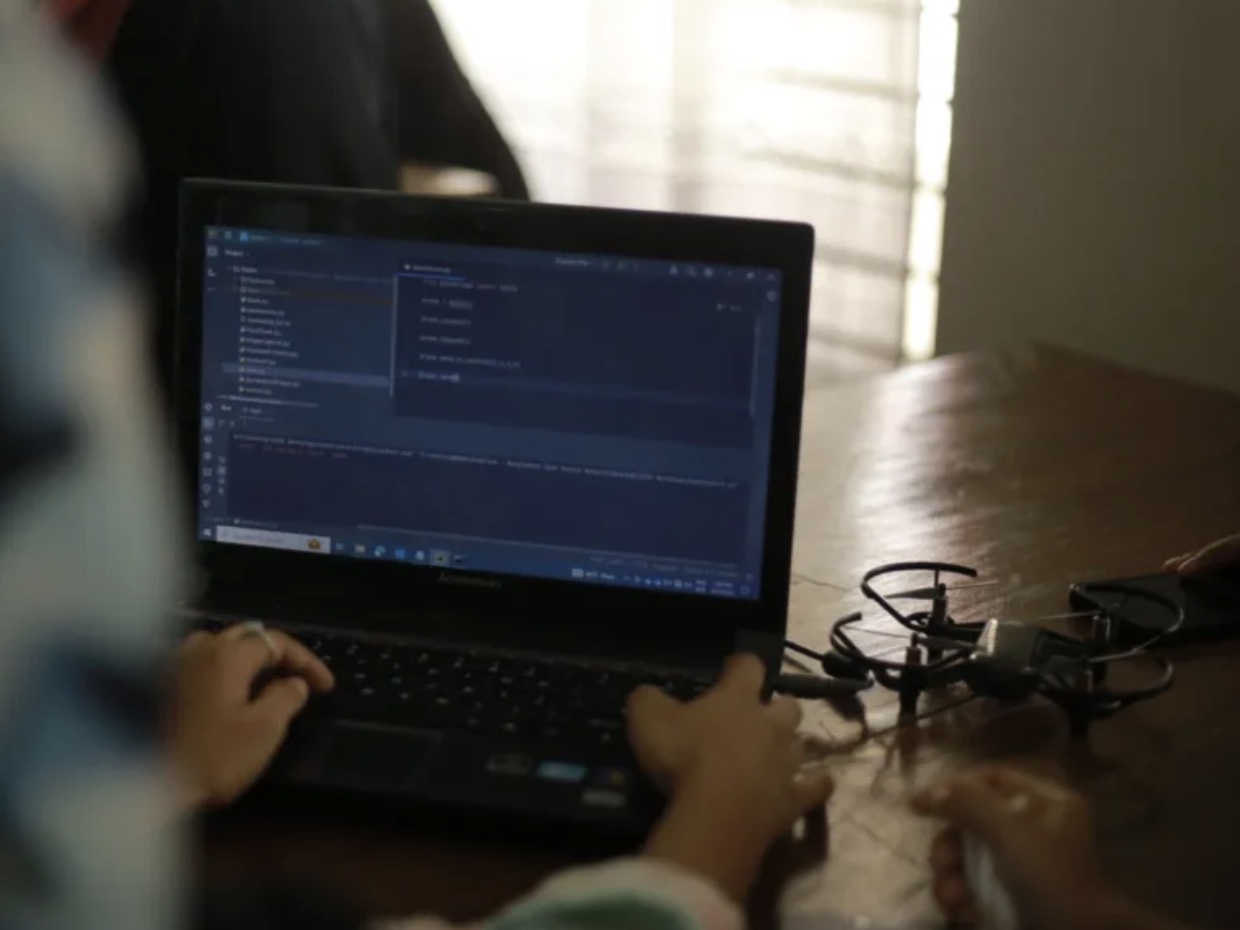
Because a computer is already doing the flying, a drone can be given its instructions in advance. A first drone program can be as simple as this:
takeoff()
forward(100)        # centimetres
rotate_clockwise(90)
forward(100)
land()
Five lines, and the aircraft flies an L-shaped path by itself. The exact commands differ from one drone to another, but the idea is the same everywhere: break a flight into steps, write the steps down, then watch whether the drone does what you meant. Usually it does not, the first time. Working out why is where the learning happens.